With recent advances in photography and sensor technology, high dynamic-range images are becoming more and
more common. In order to view such images on low dynamic range displays, there is a need to reduce the dynamic
range of such images. An algorithm for high dynamic range reduction has been developed by Image Registration
and Fusion Systems that subdivides an image into subimages and maps shadings in each subimage to a lower
dynamic range while maximizing image entropy. The mapped subimages are then smoothly stitched together to
create the low dynamic range image. The main characteristic of this software is that it preserves chroma while
reducing dynamic range in shading (luminance). An example of high-dynamic range reduction by this algorithm is
given below. Fig. 1 shows the high dynamic range Stanford Memorial Church image when mapped to a lower
dynamic range by this algorithm. The original high dynamic-range image may be obtained from
www.debevec.org/Research/HDR/. The software comes with an image viewer capable of reading and viewing
images in hdr format and saving a converted image in formats such as jpg, tif, gif, png, rgb, and ppm.
more common. In order to view such images on low dynamic range displays, there is a need to reduce the dynamic
range of such images. An algorithm for high dynamic range reduction has been developed by Image Registration
and Fusion Systems that subdivides an image into subimages and maps shadings in each subimage to a lower
dynamic range while maximizing image entropy. The mapped subimages are then smoothly stitched together to
create the low dynamic range image. The main characteristic of this software is that it preserves chroma while
reducing dynamic range in shading (luminance). An example of high-dynamic range reduction by this algorithm is
given below. Fig. 1 shows the high dynamic range Stanford Memorial Church image when mapped to a lower
dynamic range by this algorithm. The original high dynamic-range image may be obtained from
www.debevec.org/Research/HDR/. The software comes with an image viewer capable of reading and viewing
images in hdr format and saving a converted image in formats such as jpg, tif, gif, png, rgb, and ppm.
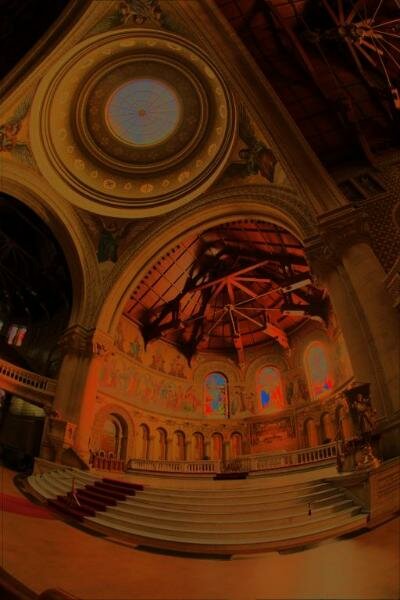
Fig. 1. (a) Dynamic range reduction of the Stanford Memorial Church image. The original image is courtesy of
Paul Debevec, debevec.org.
Paul Debevec, debevec.org.
With this software it is also possible to interactively change the image brightness while viewing the displayed
image. Intensity changes can be additive, multiplicative, exponential, or a combination of them. For instance,
brightening the image in Figs. 1 interactively produces the image in Figs. 2.
image. Intensity changes can be additive, multiplicative, exponential, or a combination of them. For instance,
brightening the image in Figs. 1 interactively produces the image in Figs. 2.
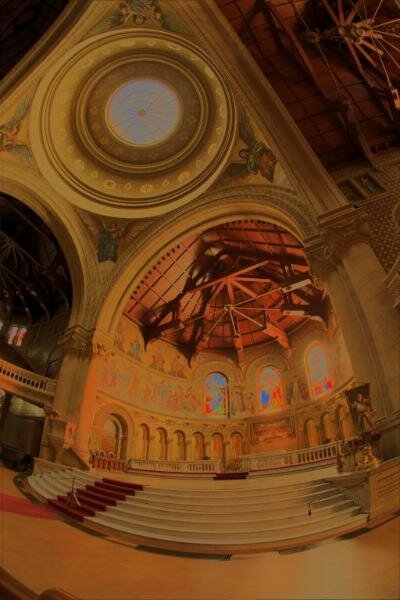
| Fig. 2. Brightening of the image in Fig. 1 by this image viewer. |
To obtain a license for this software, follow this link=>

|

|

| High dynamic-range image viewer |
| Image Registration and Fusion Systems |